
REGISTRATION
This website is for consumers, retailers and for wholesalers. Retailers and Wholesalers must register first. Your registration will be processed by the agent in charge of your country, who may contact you for that purpose. After confirmation you have access to all information.
You will find the agent in charge of your country here.
FREIGHT CHARGES & FREE SHIPPING
Your order will be processed, shipped and invoiced by the representative in charge for your country. An overview of shipping cost for each country can be opened here.
Contact details and mail address of your representative will be mentioned in the order confirmation or can be found here. No deliveries outside the listed countries.
Your order will be processed, shipped and invoiced by the representative in charge for your country. An overview of shipping cost for each country can be opened here.
Contact details and mail address of your representative will be mentioned in the order confirmation or can be found here. No deliveries outside the listed countries.
Understanding atopic dermatitis on the face & how to care for it properly
23 April 2026
Atopic dermatitis Face Skincare
Atopic dermatitis on the face: what lies behind the symptoms and which skincare truly benefits your skin
When the skin loses its balance: what lies behind atopic dermatitis on the face
Atopic dermatitis is a chronic inflammatory skin condition, but not contagious, medically referred to as atopic dermatitis. It is often caused by a disrupted skin barrier: moisture is lost more quickly, while irritants, allergens and environmental factors can penetrate the skin more easily. This typically results in dry skin, recurring inflammation and sensitive skin.
Facial skin is particularly affected because it is exposed daily to sun, wind, dry air, make-up and cleansing, as well as frequently changing products. The skin microbiome can also play a role, as an imbalance can make the skin even more vulnerable.
Key facts at a glance Overview
- Facial atopic dermatitis is a chronic, non-contagious skin condition
- A disrupted skin barrier is often at the core
- Symptoms vary depending on phase and individual
- Structured, gentle skincare can support the skin daily
- Diagnosis and treatment always belong to a doctor
Acute flare-up or non-flare phase, the difference matters
The manifestation of atopic dermatitis varies depending on the individual and the phase in which it appears more or less intensely. It is therefore important to distinguish between acute flare-ups and non-flare phases. For skincare, it is essential to know which phase you are currently in:
The distinction between acute and calmer phases is important as it allows you to adapt your skincare more precisely.
Redness, itching, tightness, how symptoms of atopic dermatitis appear on the face
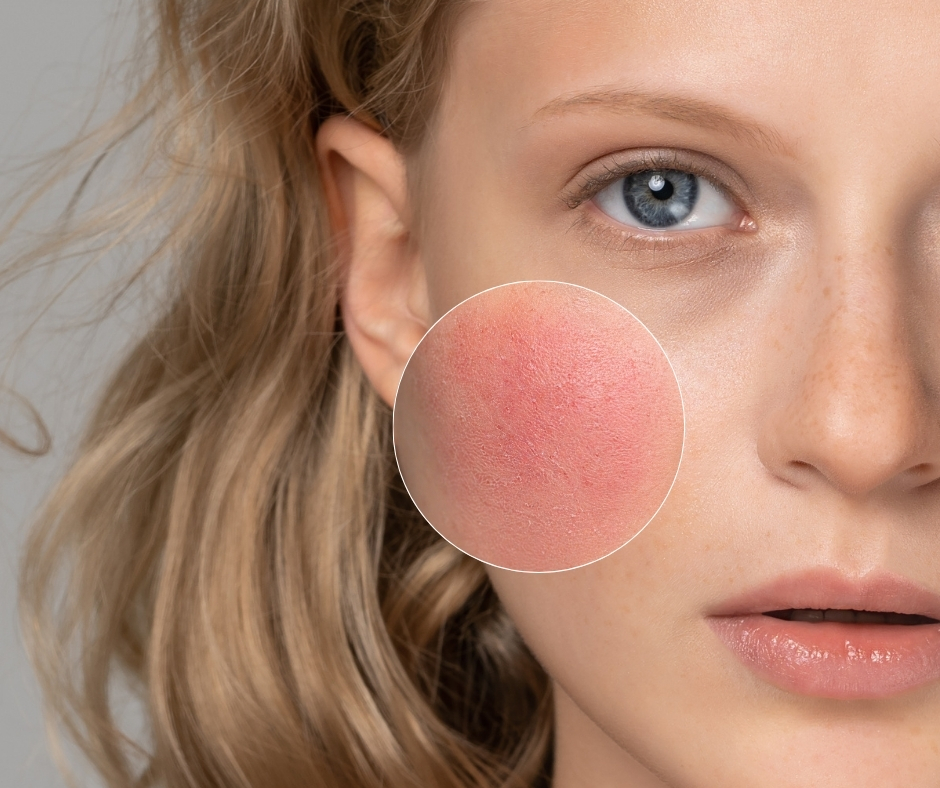
Symptoms of atopic dermatitis can vary in intensity. Some people only experience mild discomfort on the face, while others have pronounced flare-ups affecting multiple areas. The skin is often dry, flaky patches appear, the face feels tight and itching leads to scratching. Redness, rough eczema patches, small cracks and, in acute phases, sometimes weeping areas are also typical.
Fine lines and wrinkles due to chronic dryness
Redness, itching and burning
Flaky, rough or cracked skin areas
Tightness and dryness
In acute phases, weeping areas
Increased sensitivity to skincare products and environmental irritants
Frequently affected facial areas
The most commonly affected areas are the eyelids, lips, corners of the mouth and cheeks, as well as the area around the nose and mouth. The jawline, scalp or hairline can also react in some adults. Persistent irritation may lead to thickened skin and long-term sensitivity.
Photos and comparisons do not replace a diagnosis
Similar symptoms may also occur with rosacea, psoriasis, contact dermatitis, perioral dermatitis or other eczema types. Especially in unclear, severely inflamed or recurring cases, a doctor should always examine the skin.
What stresses the skin further: key triggers of atopic dermatitis
The causes of atopic dermatitis are rarely due to a single factor. Instead, they result from a combination of genetic predisposition, an atopic skin condition, a weakened skin barrier and individual triggers.
01 Environment & climate
Dry air, heating systems, cold weather, wind and UV radiation can further weaken the skin barrier and trigger flare-ups.
02 Ingredients & skincare
Fragrances, unsuitable ingredients, aggressive cleansing and frequent product changes can worsen symptoms.
03 Lifestyle & daily habits
Stress, repeated scratching, sweating, smoke, pollen, diet and daily habits such as shaving or make-up can irritate the skin.
Hier ist **Block 3, vollständig 1:1 übersetzt, ohne Kürzung, gleiche Struktur**: ```html id="b3x9kt"
What your skin barrier needs now
Less is often more
If your skin is prone to atopic dermatitis, a minimalist and structured routine usually works better than constantly changing products. The main objectives are:
- Retain moisture
- Reduce dryness
- Stabilise the skin barrier
- Avoid additional inflammation
A gentle cleanser is essential, as overly degreasing products can make the skin even drier. The skin then needs a basic skincare routine that combines lipid-replenishing and hydrating properties. Especially in cases of dry and itchy facial skin, consistent daily care can help reduce tightness and make the skin feel calmer over time.
Key takeaway: It is not the number of products that matters, but their tolerance and consistent application.
Key takeaway
Anyone caring for facial skin affected by atopic dermatitis should always consider skincare, ingredients and daily habits together.
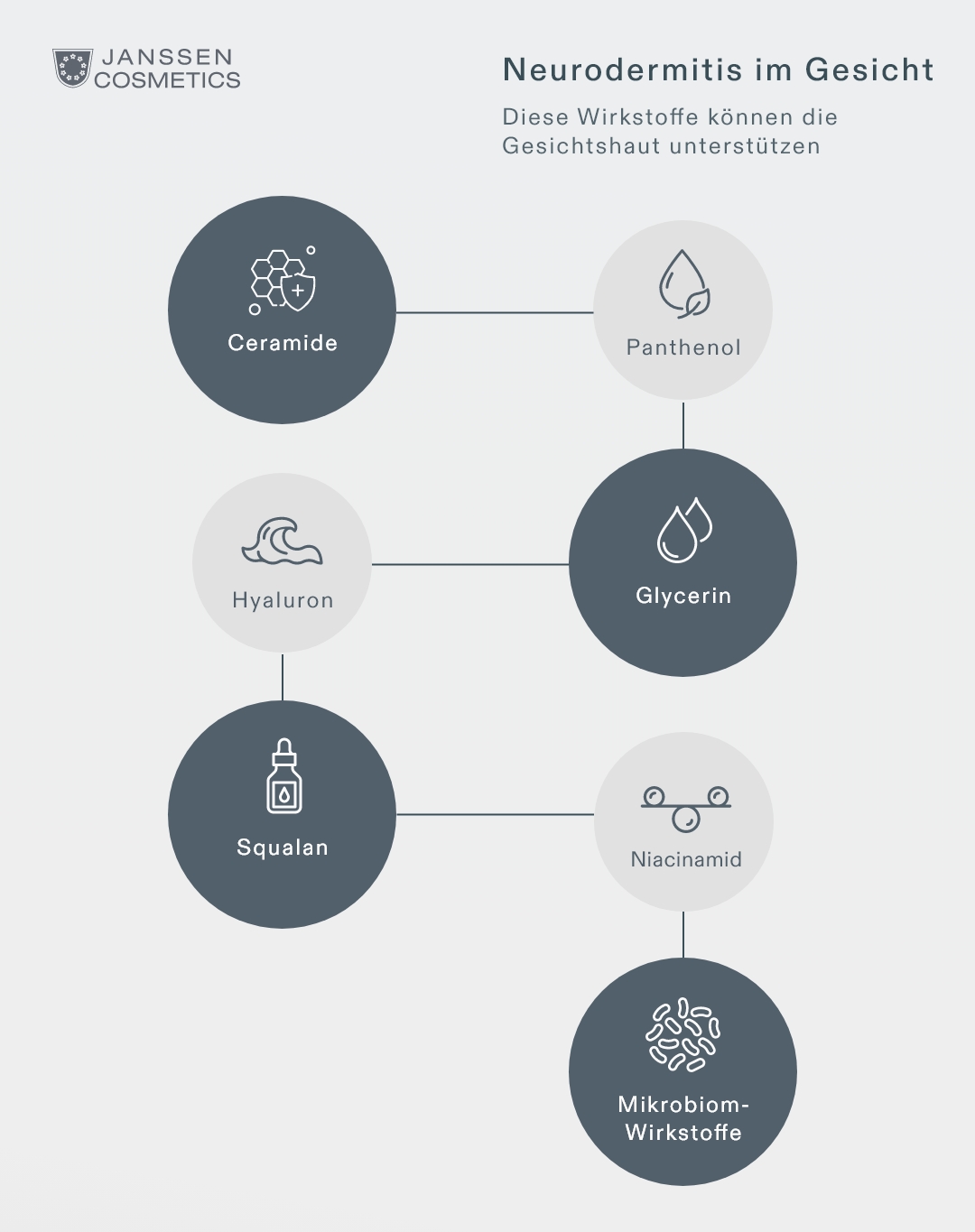
These active ingredients can support facial skin
The treatment of atopic dermatitis on the face is the responsibility of a doctor when it comes to diagnosis and medical therapy. From a cosmetic perspective, however, a well-formulated skincare product can help soothe the skin and complement the daily basic therapy.
The overall formulation is crucial. It is not only individual active ingredients that determine whether a product is beneficial, but also the texture, absence of fragrance, good tolerance and gentle application.
```
Cleanser, serum, balm: which skincare products are useful in daily routine?
A good facial skincare routine for skin affected by atopic dermatitis begins with a gentle cleanser. An alcohol-free toner may follow, but only if the skin tolerates it well. A soothing serum can optionally complement the routine.
01 Gentle cleanser
A good facial skincare routine for skin affected by atopic dermatitis begins with a gentle cleanser. An alcohol-free toner may follow, but only if the skin tolerates it well. A soothing serum can optionally complement the routine.
02 Cream or balm
The central step is usually a cream or balm that strengthens the skin barrier, provides hydration and protects the skin from further dryness. Light textures can be pleasant during the day, while richer creams are more suitable when dryness, cold weather or stressed skin conditions are dominant.
03 Sun protection
During the day, a well-tolerated sun protection is essential, as sunlight and UV radiation can further stress sensitive skin.
Facial skincare without irritants in atopic dermatitis: what truly matters
Especially in the case of atopic dermatitis on the face, skincare should be as gentle, transparent and structured as possible. Sensitive skin often reacts strongly to too many products, unnecessary ingredient combinations or frequently changing formulations.
A minimalist routine therefore often works better than many specialised products: a gentle cleanser, a well-tolerated serum if needed and a barrier-strengthening cream are often sufficient on a daily basis to keep facial care clear, calming and reliable.
Gentle cleansing
Without stressing the skin barrier
Soothing serum
Optional and only if tolerated
Barrier cream
Hydrating and lipid-replenishing
Sun protection
Daily essential
First aid during flare-ups: when to consult a doctor
If the skin suddenly becomes intensely itchy, tight or visibly irritated, reducing the routine is key. Use as few products as possible, avoid irritants and focus on soothing, lipid-replenishing care.
If areas remain open, weeping, severely inflamed or painful, medical advice should be sought immediately.
Atopic dermatitis and ageing: why symptoms may change
Atopic dermatitis does not necessarily begin in childhood. It can also appear for the first time in adulthood or change over time. Skin becomes thinner and drier with age, making a tailored routine even more important.
Conclusion
Skincare can support the skin but cannot replace a diagnosis. With a structured, gentle routine, skin affected by atopic dermatitis can be supported long-term without being overwhelmed.
FAQ
Above all, a low-irritant skincare routine is helpful, including gentle cleansing, moisturizing and emollient creams, and a well-tolerated sunscreen. It is equally important to identify personal triggers and seek medical advice if symptoms are severe or unclear.
For facial eczema, a cream that is suitable for sensitive skin, low in fragrance and irritants, and supports the skin barrier is recommended. Active ingredients such as ceramides, glycerin, panthenol, hyaluronic acid, or squalane can be beneficial for dry, irritated facial skin, depending on the formulation.
Yes, makeup is often possible during flare-up-free periods. It’s important to use well-tolerated products, cleanse gently, and avoid formulations that could further trigger itchy skin or redness. During acute flare-ups, it’s usually better to use fewer decorative cosmetics.